
Anyone pricing out a full set of implants runs into the same wall: quotes swing from $15,000 to well past $60,000, and almost nobody explains the gap. A good part of the confusion is vocabulary. “Full dental implants” covers at least three different treatments at three very different price points, which is why implant-focused practices like Stubbs Dental publish cost ranges by treatment type instead of a single headline number. Once you know which treatment you are actually being quoted for, the math stops feeling arbitrary.
What are dental implants, and what makes a set “full”?
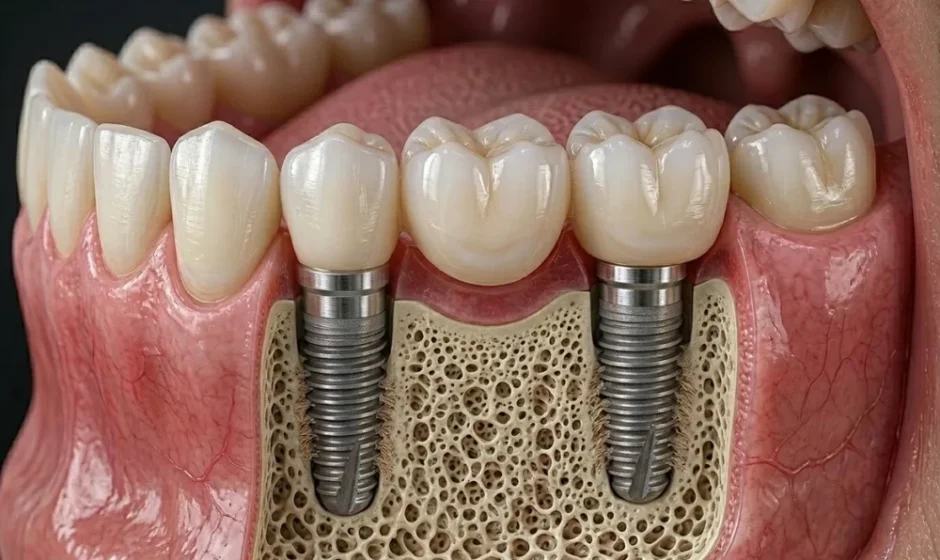
A dental implant is a small titanium or zirconia post surgically placed into the jawbone to take the place of a missing tooth root. Over the following three to six months the bone grows against and around it, a process called osseointegration. Once that bond is solid, a connector piece known as an abutment links the post to whatever sits above the gumline: a crown, a bridge, or a denture.
“Full arch” means one jaw, upper or lower. “Full mouth” means both. And replacing every tooth does not mean placing an implant for every tooth. Standard protocols use four to six implants per jaw to carry an entire arch of teeth.
How much do full dental implants cost in 2026?
In the United States, expect these per-arch ranges:
- Implant-retained overdenture (two to four implants, prosthesis snaps out for cleaning): $7,000 to $15,000
- Fixed full-arch bridge on four to six implants, the category that includes All-on-4 and similar protocols: $20,000 to $35,000
- Individual implants with separate crowns across a whole arch: $3,000 to $6,000 per tooth, which is why almost no one does it this way
For both arches fixed, most patients land somewhere between $40,000 and $70,000. Material choice moves the needle significantly. An acrylic-on-titanium bridge sits at the lower end, while monolithic zirconia typically adds $3,000 to $8,000 per arch and resists chipping and staining far better over a decade of use.
Why do two quotes for the same mouth differ by $20,000?
Because they are rarely measuring the same thing. One office quotes surgery only. Another bundles extractions, the temporary prosthesis, sedation, and the final restoration into one figure. Before comparing numbers, ask each practice for a written treatment plan with itemized codes.
Other real drivers: whether a periodontist or oral surgeon places the implants, whether the lab is in-house, regional cost of living, and how much preparatory work your jaw needs.
What usually gets billed separately?
These line items are the ones that surprise people after they have already committed:
- Cone beam CT scan (3D imaging used for surgical planning): $150 to $500
- Tooth extractions: $150 to $650 each, higher for surgical removals
- Bone graft: $400 to $1,200 per site
- Sinus lift, often needed for upper back implants: $1,500 to $3,000
- Night guard to protect the final bridge: $300 to $800
Bone grafting is the most common cost escalator. Jawbone starts resorbing within months of tooth loss, so someone who has worn a traditional denture for several years is more likely to need it than someone whose teeth were removed recently.
Does dental insurance cover full implants?
Partially, at best. Most dental plans carry an annual maximum between $1,000 and $2,000, and many still classify implants as a major or elective service covered at 50 percent. That ceiling gets consumed quickly by extractions and imaging alone. Original Medicare generally does not cover implants, though some Medicare Advantage plans include limited dental benefits.
Practical workarounds people actually use: HSA and FSA dollars, third-party financing, and phasing treatment across two calendar years so two annual maximums apply. Ask whether the practice offers in-house membership plans, which often discount the surgical portion outright.
Is the price justified compared to dentures?
A conventional full denture runs roughly $1,500 to $3,000 per arch, so the gap is real. The comparison changes once you factor in the replacement cycle. Dentures need relines every one to two years and full replacement every five to seven, and because nothing stimulates the jawbone underneath, the fit keeps drifting. Implants interrupt that resorption. Published systematic reviews consistently put implant survival above 90 percent at ten years, with many studies near 95 percent. Verify current figures through the American Academy of Implant Dentistry or the American Dental Association before relying on any specific number.
Function matters too. Implant-supported teeth restore a large share of natural bite force, which is the difference between eating an apple and cutting it into pieces.
Getting an accurate number for your own mouth
No article can price your case, because bone volume, gum health, and how many teeth are still salvageable change the plan entirely. What you can do is arrive at a consultation asking the right questions: what is included in this figure, what is not, what happens if I need grafting, and what does the warranty cover. A CBCT scan and a written, itemized plan should come before any deposit.
If you are in the early research stage, browse the treatment and cost guides published by Stubbs Dental to see how a full-arch plan is structured, then book a consultation with an implant provider near you and have them walk through the estimate line by line.